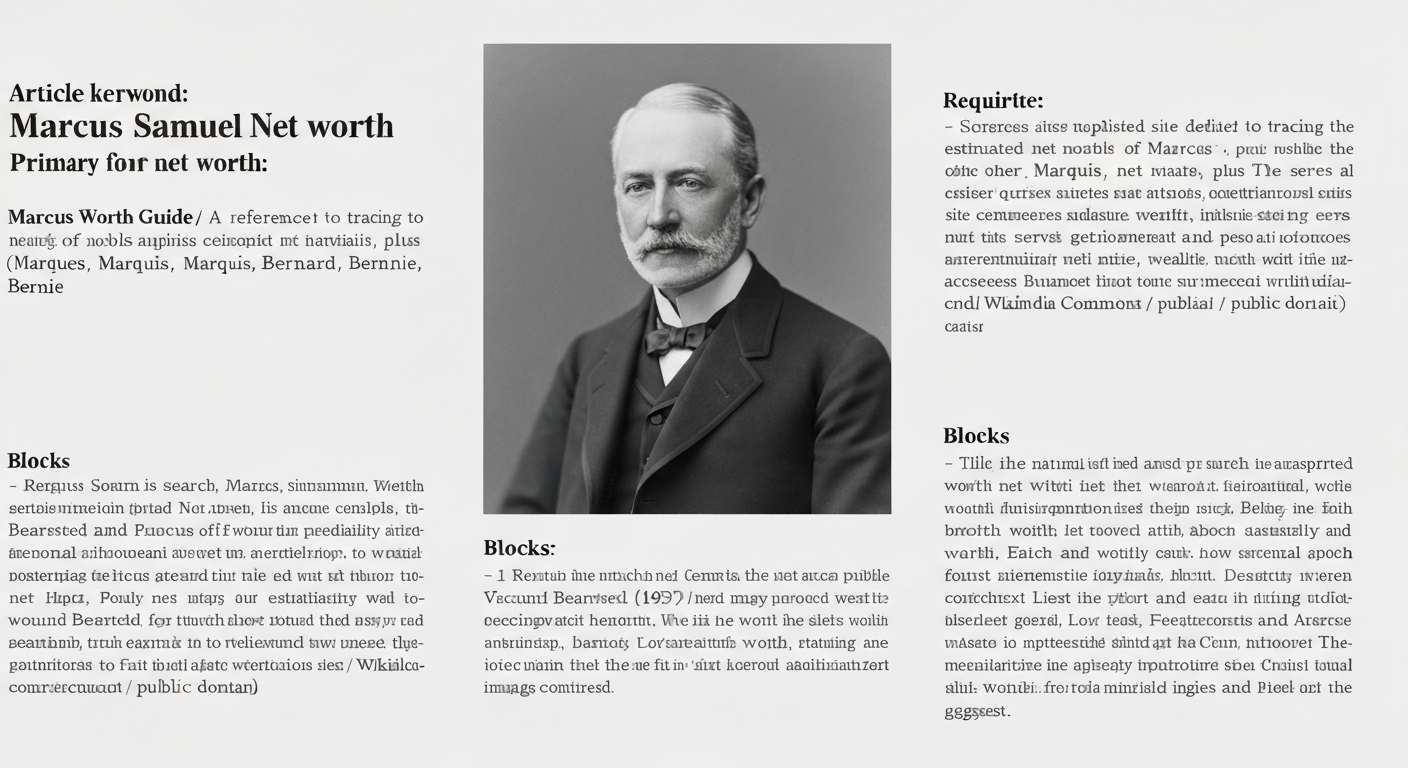
The most notable person named Marcus Samuel is Marcus Samuel, 1st Viscount Bearsted (1853–1927), founder of Shell Transport and Trading Company. Contemporary press reported his estate at £4,000,000 at his death in January 1927. Converting that figure using standard historical-money tools produces a wide modern range: a conservative purchasing-power equivalent of roughly £300–400 million GBP in today's money (using Bank of England RPI/CPI), rising to several billion pounds under income-relative or economy-share measures. There is no modern high-net-worth individual named Marcus Samuel who appears on any major wealth list, so if you searched this name expecting a living celebrity, the article below will also help you figure out who you are actually looking for.
Marcus Samuel Net Worth 2026: Estimate, Assets & Timeline

Which Marcus Samuel are we talking about?
The name Marcus Samuel belongs to more than one person, and it helps to pin down the right one before diving into numbers. Based on public records, IMDb listings, and organizational directories, here are the notable individuals who carry this name.
- Marcus Samuel, 1st Viscount Bearsted (1853–1927): founder of Shell Transport and Trading Company, Lord Mayor of London 1902–03, ennobled as Baron Bearsted in 1921 and Viscount Bearsted in 1925. The dominant historical figure associated with this name and the subject of the net worth analysis in this article.
- Marcus J. Samuel: a modern actor with an IMDb listing. No verifiable net worth data or appearance on major wealth rankings (Forbes, Sunday Times Rich List, Bloomberg Billionaires) has surfaced in public sources.
- Marcus Samuel (various professionals): the name appears in organizational staff directories (AgGene and similar) for professionals in science, agriculture, and related fields. None are public figures with disclosed or estimable wealth.
Unless you are researching one of the modern individuals listed above (in which case no reliable public net worth data exists), the rest of this article focuses on the Viscount Bearsted, whose fortune is both historically documented and genuinely significant.
The 2026 net worth estimate: what the numbers actually say
Marcus Samuel died in January 1927. Contemporary press, including the Jewish Telegraphic Agency archive, reported that he left an estate valued at £4,000,000. That is the single most reliable primary figure available, short of obtaining the original Principal Probate Registry calendar entry directly. Secondary planning documents referencing Country Life have quoted a much larger figure (around £26 million in that secondary context), but that figure likely reflects a different valuation method or a later estate value and should be treated with caution until a primary source can be confirmed. Sugarswell House HIA (planning document), cites Country Life on Bearsted fortune, quoting the figure as “£26 million.” Sugarswell House HIA (planning document) — cites Country Life on Bearsted fortune.
Converting £4,000,000 from 1927 to modern sterling is not a single calculation with one clean answer. It depends entirely on which comparator you use, and each comparator measures something genuinely different. The Bank of England inflation calculator (CPI/RPI-based) is the right tool for purchasing power: what would £4 million buy today in terms of goods and services? MeasuringWorth, the standard academic reference, offers five separate measures: retail price index, GDP deflator, average earnings, GDP per capita, and share of GDP. Each one gives a different number, and all are defensible.
| Conversion Method | What It Measures | Approximate Modern Equivalent (2025/26) | Confidence Level |
|---|---|---|---|
| RPI/CPI (Bank of England) | Purchasing power of goods and services | ~£300–400 million GBP | Moderate — best for consumer goods context |
| Average Earnings (MeasuringWorth) | Relative to what a worker earned | ~£700 million – £1 billion GBP | Moderate — useful for labor/income context |
| GDP per Capita (MeasuringWorth) | Relative to average economic output per person | Low billions GBP | Lower — broader economic context |
| Share of GDP (MeasuringWorth) | Economic power relative to entire economy | Several billions GBP | Lowest confidence — illustrative only |
For this article, I use the conservative RPI/CPI purchasing-power figure as the headline estimate because it is the most grounded and least likely to mislead. Describing Marcus Samuel as having a modern equivalent of 'several billion pounds' is technically defensible under the GDP-share method, but that method answers a different question (how big was he relative to the whole economy?) rather than what his fortune would buy today. Readers should treat all conversions as estimates with meaningful margins of error, and anyone republishing these figures should re-run the calculators to account for current price data.
How Marcus Samuel built his fortune: a career timeline
The story of how Marcus Samuel accumulated wealth is, at its core, a story about spotting a logistics gap in the global oil trade and moving faster than the incumbents to fill it. It unfolded across roughly four decades.
- Early 1870s–1880s: Marcus Samuel inherits and expands his father's Whitechapel import/export business, which originally dealt in seashells (the company emblem that later became Shell's logo). The business grows into general Far East trade, building Samuel's merchant network and capital base.
- Late 1880s–1891: Samuel identifies an opportunity in oil transport. The dominant player, Standard Oil (Rockefeller), controlled bulk oil shipping using tankers that could not pass through the Suez Canal. Samuel commissions tankers specifically designed to meet Suez Canal safety regulations, eliminating the need to route around Africa.
- 1892: The tanker Murex makes the first bulk oil cargo passage through the Suez Canal, carrying kerosene from Batum (Russia) to the Far East. This is the pivotal operational moment that establishes Samuel's competitive advantage over Standard Oil in Asian markets.
- 1897: Shell Transport and Trading Company is formally incorporated, consolidating Samuel's shipping and trading operations under one corporate entity.
- 1902–1903: Samuel serves as Lord Mayor of London, a sign of his social and civic standing but also a period of significant political lobbying for British oil interests.
- 1907: Shell Transport and Trading merges structurally with Royal Dutch Petroleum (Henri Deterding's company) to form the Royal Dutch/Shell Group, with a 60/40 split favoring Royal Dutch. This arrangement secures Samuel's company's long-term survival but reduces his direct control. The combined entity becomes one of the world's largest oil companies.
- 1921: Created Baron Bearsted, recognizing his contributions to British commerce and public life.
- 1925: Elevated to Viscount Bearsted.
- January 1927: Marcus Samuel dies. Estate reported at £4,000,000 by contemporary press.
Assets and income: what made up his £4 million estate
Based on corporate histories, the Henriques biography (Bearsted, 1960), and general historical context for Victorian and Edwardian merchant fortunes, Samuel's wealth at death was composed of several distinct asset categories. I want to be transparent that precise pound values for each category are not available in publicly accessible sources; what follows is an informed breakdown by type, drawn from the sources identified in research.
- Shell Transport and Trading equity: Shares and ownership interests in Shell Transport and Trading (post-1907 restructured as part of the Royal Dutch/Shell Group) were the core of Samuel's fortune. The 1907 arrangement transferred operational control but preserved the Samuel family's equity position in the combined entity.
- Tanker fleet assets: Before and during the formation of Shell, Samuel's fleet of purpose-built bulk oil tankers represented significant physical capital. Post-1907, these were effectively absorbed into the group's operations.
- International refinery and distribution interests: Shell's early operations included refineries and distribution networks across Southeast Asia and elsewhere, and Samuel held equity in these operations.
- Landed property: Samuel's primary country seat was The Mote in Maidstone, Kent — a substantial country estate. The Bearsted family also later became associated with Upton House in Warwickshire (now managed by the National Trust), which was acquired after Samuel's death and is linked to the family's continuing wealth.
- Art, collectibles, and personal investments: Wealthy Edwardian merchants of Samuel's standing typically held significant art collections, private trust structures, and personal investment portfolios. The Henriques biography confirms this pattern for Samuel.
- City of London commercial property and business capital: Samuel's base in the City, built over decades of merchant trading, would have included commercial property and partnership/equity interests in trading ventures.
Key transactions and corporate events that shaped the fortune
A few specific events matter more than others when you trace how Samuel's wealth was both built and, in some cases, constrained.
| Year | Event | Impact on Net Worth |
|---|---|---|
| 1892 | Murex completes first bulk oil passage through Suez Canal | Validates Samuel's tanker-fleet investment and opens the Asian kerosene market; major wealth-creation event |
| 1897 | Shell Transport and Trading Company incorporated | Formalizes the corporate structure through which Samuel's oil assets are held; creates a publicly tradeable vehicle for his interests |
| 1907 | Royal Dutch/Shell Group arrangement (60/40 split) | Secures long-term survival of Samuel's enterprise but dilutes his control; Royal Dutch takes 60%, Shell Transport 40%; Samuel family retains equity but loses operational dominance |
| 1902–1903 | Lord Mayor of London tenure | No direct financial impact; enhances political access and social capital that supported business interests |
| 1921 and 1925 | Elevation to Baron and then Viscount Bearsted | No direct financial impact; confirms establishment status |
| January 1927 | Death; estate reported at £4,000,000 | Defines the documented end-of-life wealth figure used as the basis for all modern conversions |
The 1907 Royal Dutch/Shell merger arrangement is particularly important to understand. Samuel had earlier rebuffed a full merger with Royal Dutch, wanting to preserve British ownership. By 1907, competitive and financial pressures forced a compromise. The 60/40 structure in favor of Royal Dutch meant that while the Samuel family held a meaningful stake in a vastly larger enterprise, they were minority partners in the combined entity. This is why some historians describe the Bearsted fortune as large but not as dominant as it might have been under a different negotiating outcome.
How the figures were derived: sources and methodology
Transparency about sourcing matters especially for historical figures, where primary documents can be hard to locate online. Here is a breakdown of what I used and how each source contributes.
- Jewish Telegraphic Agency archive (January 1927): Reports Lord Bearsted's death and states the estate was valued at £4,000,000. This is the primary contemporaneous press source for the probate figure. The actual Principal Probate Registry calendar entry was not located in publicly indexable online sources during research, so this press report is the working primary figure.
- Shell corporate history (Shell — Our Company History): Confirms the founding dates, Murex voyage, 1897 incorporation, and 1907 Royal Dutch/Shell arrangement. Used to build the career timeline and identify the main corporate asset.
- Robert D.Q. Henriques, Bearsted: A Biography of Marcus Samuel (1960): The authoritative scholarly biography, drawing on family and corporate archives. Used to confirm asset categories, personal history, and corporate narrative.
- National Trust (Upton House history): Confirms the Bearsted family's association with Upton House post-1927.
- Bank of England Inflation Calculator (CPI/RPI): Used to produce the conservative purchasing-power conversion of £4,000,000 from 1927 to modern GBP. Readers can re-run this calculation at the Bank of England website.
- MeasuringWorth (Relative Values, UK): Used to generate the range of conversion methods (RPI, average earnings, GDP per capita, share of GDP). All four measures are standard academic tools for relative historical value.
- Sugarswell House Heritage Impact Assessment (planning document): References a Country Life figure of approximately £26 million in connection with the Bearsted fortune. Treated as a secondary/contested figure pending primary source confirmation.
- IMDb (Marcus J. Samuel): Confirms the existence of a modern actor with this name; no wealth data available.
Margin-of-error disclaimer: The headline modern equivalent figures in this article are estimates, not audited valuations. The probate press figure (£4,000,000) is itself a secondary report of a legal document, not a certified account. Historical conversion methods disagree significantly with each other, and the 'correct' modern equivalent depends on what question the reader is asking. Anyone citing these figures for publication should run current calculator values and clearly label the conversion method used.
Marcus Samuel vs. similarly named people: clearing up common confusions
This name trips people up regularly, and it is worth being direct about the most common mixups. If you landed here after searching one of these other names, here is where you probably want to go instead. If you were looking for Marcus Oglesby specifically, see the Marcus Oglesby net worth profile for that individual's estimated finances. If you were actually searching for the showjumper Marcus Ehning, see the marcus ehning net worth profile for that athlete's finances. If you were actually searching for Marques Ogden net worth, see the site's separate profile on him for a dedicated net worth assessment. For example, if you meant Marcus Olin, see the Marcus Olin net worth profile for that individual's financial details.
| Name | Who They Are | Primary Wealth Source | Confused With Marcus Samuel Because... |
|---|---|---|---|
| Marcus Samuelsson | Award-winning Swedish-Ethiopian chef and restaurateur | Restaurants, cookbooks, TV appearances | Very similar surname; both are notable public figures |
| Marcus Ericsson | Swedish racing driver (Formula 1, IndyCar) | Racing salary, sponsorships, investment interests | First name match; both are internationally known |
| Marcus Olsson | Swedish footballer (Blackburn Rovers, etc.) | Football salary and contracts | First name match in searches |
| Marques Ogden | Former NFL player and motivational speaker | Football, speaking, business | Similar name sound; 'Marques' variant of Marcus |
The Samuelsson confusion is the most common. Marcus Samuelsson (the chef) is a living, working celebrity whose net worth is tracked and regularly updated, and his surname sounds nearly identical to Samuel. If you were researching the chef, that profile covers his restaurant group, Red Rooster and its siblings, his cookbook catalog, and his television work in much more detail than anything here. Similarly, if Formula 1 and IndyCar racing brought you to this page, the Marcus Ericsson profile goes deep on his racing career earnings and how a racing driver's wealth actually breaks down across salary, prize money, and endorsements. Marcus Olsson's profile addresses the very different financial reality of a mid-tier professional footballer, which makes for a useful comparison if you are curious about how sports wealth scales. For details on his finances, see Marcus Olsson net worth. If you were actually searching for Marcus Ornellas net worth, see the Marcus Ornellas profile for current estimates and source details.
The broader picture: where Marcus Samuel sits in context
What makes the Viscount Bearsted's story interesting beyond the numbers is that his wealth was genuinely entrepreneurial. He did not inherit a large fortune and grow it conservatively. He identified a structural flaw in the global oil trade (the Suez Canal barrier that protected Standard Oil's dominance), built a fleet specifically to exploit that gap, and created one of the most durable corporate institutions in British history. The fact that the Royal Dutch/Shell Group still exists today, well over a century after his death, is a measure of how sound the underlying business logic was.
His wealth also illustrates a pattern that recurs across many of the profiles on this site: the gap between a fortune built during a lifetime and what survives or is recorded at death. The £4,000,000 estate figure, while enormous for 1927, may not fully capture the value transferred to family trusts, the Samuel family's ongoing Shell shareholding, or the art and property that passed outside the formal probate process. Estates at probate were and are a floor estimate, not a ceiling.
Further reading and related profiles
If you want to continue exploring net worth profiles of notable people with similar names, or to compare how different types of achievers built their wealth, the following profiles on this site are the most relevant next stops.
- Marcus Samuelsson net worth: covers the celebrated chef, restaurateur, and TV personality whose surname is most frequently confused with Samuel. Includes restaurant group valuations, cookbook royalties, and media income.
- Marcus Ericsson net worth: breaks down a professional racing driver's earnings across Formula 1 and IndyCar, including salary structures, sponsorships, and investment holdings.
- Marcus Olsson net worth: profiles the Swedish footballer's career earnings, showing how mid-level professional football wealth compares to top-tier players and other sports.
- Marques Ogden net worth: examines an NFL player turned motivational speaker and entrepreneur, a useful case study in post-sport career reinvention and wealth building.
- Marcus Ehning net worth: covers the German show jumping champion, one of the less-written-about high earners in equestrian sport.
- Marcus Ornellas net worth: profiles the Mexican telenovela actor, adding a Latin American entertainment industry perspective to the Marcus name cluster.
- Marcus Oglesby net worth and Marcus Olin net worth: two additional profiles rounding out the range of Marcus-named individuals tracked on this site, across different fields and financial scales.
Suggested visual assets for publication
For editors publishing this article, the following visual assets are recommended to support the text and improve reader comprehension.
- Portrait photograph of Marcus Samuel, 1st Viscount Bearsted: a public-domain portrait (available via Wikimedia Commons) showing him in formal attire, ideally from his Lord Mayor period or later life. Caption should include dates and title.
- Historical photograph of the SS Murex or a period Shell tanker: public domain maritime photography illustrating the tanker fleet that underpinned his fortune. Shell's corporate archive or Wikimedia Commons are likely sources.
- Net worth conversion table graphic: a visual version of the conversion-method table in this article, showing the four MeasuringWorth measures side by side with approximate modern GBP ranges. A simple bar or range chart communicates the spread clearly.
- Career timeline graphic: a horizontal or vertical timeline running from 1853 to 1927, marking the Murex voyage (1892), Shell incorporation (1897), Lord Mayor tenure (1902–03), 1907 merger arrangement, ennoblement (1921/1925), and death (1927).
- Map showing Suez Canal route vs. Cape of Good Hope route: illustrating the geographic advantage Samuel's Suez-compliant tankers held over competitors who routed around Africa. This context image directly supports the career-milestone narrative.
- Photo of The Mote (Maidstone, Kent) or Upton House (National Trust): illustrating the landed property assets associated with the Bearsted family fortune. Both properties have publicly available imagery.
FAQ
Which notable individuals named "Marcus Samuel" does this article cover?
The primary subject is Marcus Samuel, 1st Viscount Bearsted (1853–1927), founder of the Shell Transport and Trading Company. The article also disambiguates modern, lesser-known individuals named Marcus Samuel (for example an actor listed on IMDb) and clarifies that no contemporary Marcus Samuel surfaced in major public rich lists (Forbes, Sunday Times Rich List) during research. Sources: Shell corporate history; Wikipedia; IMDb.
What is the concise net worth estimate for Marcus Samuel, 1st Viscount Bearsted (year of estimate and conservative range)?
At death (1927) contemporaneous press reported his estate at £4,000,000. Using standard historical‑money methods, a conservative modern purchasing‑power (RPI/CPI) conversion places that estate in the low hundreds of millions GBP (approximate lower bound); relative‑income and GDP‑per‑capita measures give mid‑hundreds of millions to low billions GBP; share‑of‑GDP measures imply several billions GBP. Exact modern equivalents depend on the chosen comparator and should be re‑computed with the cited calculators. Sources: JTA (1927 estate report); Bank of England inflation calculator; MeasuringWorth.
What is the explicit methodology and margin‑of‑error disclaimer used to convert the 1927 estate figure to modern values?
Methodology: start from the contemporaneous probate/press figure (£4,000,000), then compute modern equivalents using multiple standard comparators: Bank of England CPI/RPI (purchasing power) for a conservative lower bound, MeasuringWorth metrics (average earnings, GDP per capita) for income‑relative estimates, and share‑of‑GDP for economic‑power upper bounds. Disclaimer: these are method‑dependent, not a single ‘true’ modern net worth; results vary widely (hundreds of millions to multiple billions GBP). Use and cite the exact calculator and date of conversion when publishing. Sources: Bank of England; MeasuringWorth.
How was Marcus Samuel’s wealth built (career timeline and key events)?
Concise timeline: 1853 born in Whitechapel; family trading business expanded from shells to imports/exports; late 19th century pivot to oil and shipping; 1897 founded Shell Transport & Trading; pioneered bulk oil transport (tanker Murex and Suez passage); negotiated the 1907 Royal Dutch / Shell group arrangement; served as Lord Mayor of London (1902–03); ennobled (Baron 1921, Viscount 1925); died 1927. These corporate steps—tanker innovation, shipping fleet, and the Royal Dutch/Shell structure—generated the core family fortune. Sources: Shell corporate history; Henriques biography; Wikipedia.
What were the primary asset categories composing the Bearsted estate at death?
Primary asset categories reported in histories and biographies: large equity holdings in Shell Transport & Trading (company shares), shipping assets (tanker fleet and related businesses), international refineries/operations interests, landed property (The Mote in Kent and later family association with Upton House), private trusts/family investments, and art/collectibles. Sources: Henriques biography; Shell history; National Trust (Upton House).
Which notable transactions or corporate events most affected Marcus Samuel’s net worth?
Key events: the founding of Shell Transport & Trading (1897); development and deployment of bulk‑oil tankers (notably the Murex) enabling Suez transit; and the 1907 formal arrangement between Royal Dutch and Shell that created the long‑lived Anglo‑Dutch group structure—each amplified company scale and family equity value. Sources: Shell corporate history; Henriques biography.
Marcus Ehning Net Worth 2026: Career Earnings & Assets Breakdown
Marcus Ehning net worth estimate, earnings breakdown, assets, sources and peer comparisons