
Marcus Licinius Crassus was almost certainly the wealthiest private individual in Roman history, and modern estimates of his fortune typically land somewhere between $2 billion and $20 billion in today's US dollars, depending on the methodology you use. In British pounds sterling (using an approximate April 2026 exchange rate of around £1 = $1.27), that translates to roughly £1.6 billion to £15.7 billion. Those ranges are wide on purpose: converting ancient Roman wealth into modern currency is genuinely difficult, and anyone giving you a single precise number is overconfident. What follows is a breakdown of where those figures come from, what the ancient sources actually say, and how to interpret the estimate sensibly.
Marcus Licinius Crassus Net Worth: USD and GBP Estimate

Daniel Rothstein
26 Apr 2026
Who Marcus Licinius Crassus was, and why people search his net worth
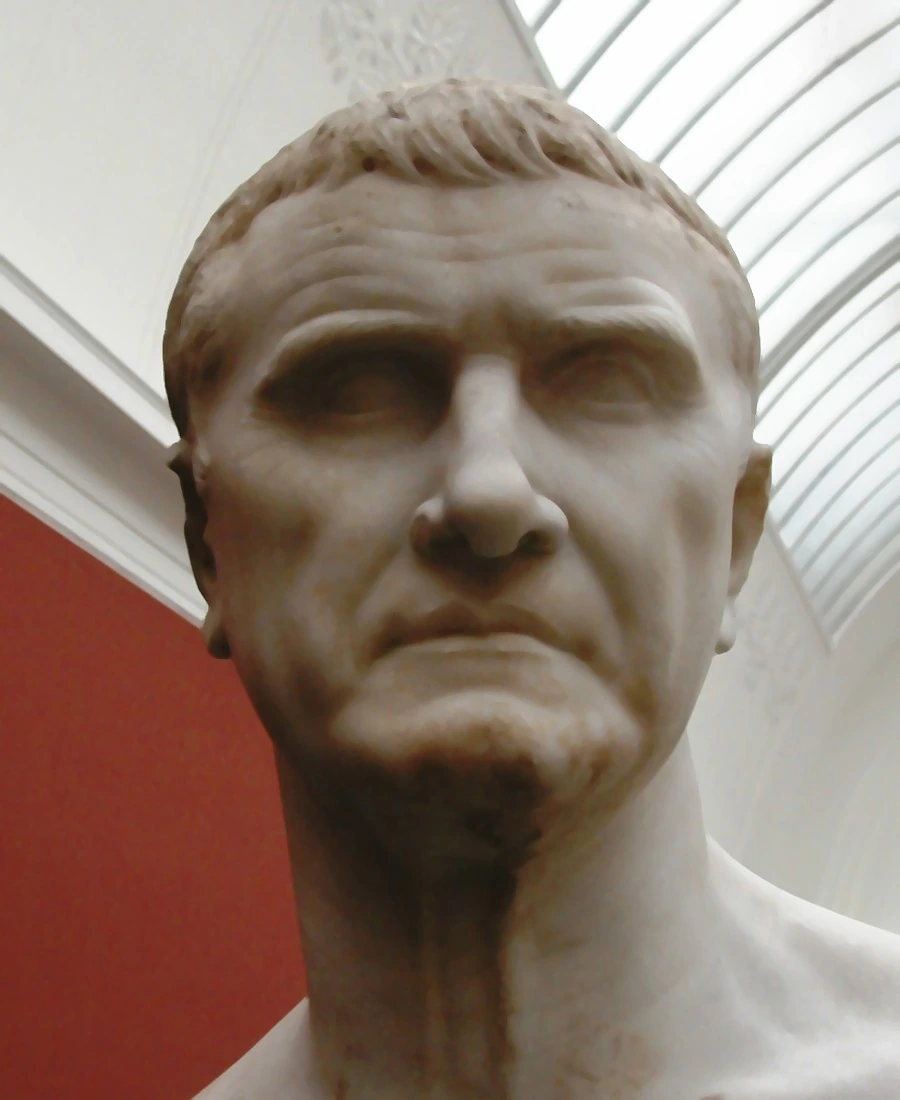
Crassus lived from roughly 115 BC to 53 BC and was a Roman statesman, general, and financier during the late Republic. He is best known as one-third of the First Triumvirate, the informal political alliance he formed with Julius Caesar and Pompey the Great. He was also famous in antiquity for being spectacularly rich, earning the nickname 'Dives' (Latin for 'the wealthy'). His life ended badly at the Battle of Carrhae in 53 BC, where he led a disastrous military campaign against the Parthian Empire and was killed, according to Britannica, near what is now Harran in modern Turkey.
People search for his net worth for a few different reasons. Some are students or history buffs who have just read about him and want a modern frame of reference. Some are curious whether ancient wealth can meaningfully be compared to today's billionaires. In particular, the same uncertainty applies when people look up Marcus Veltri net worth rather than a historical figure’s wealth whether ancient wealth can meaningfully be compared to today's billionaires.
And occasionally people land here after searching for a modern 'Marcus' or celebrity with a similar name. For context, Marcus Prinz von Anhalt is a modern figure whose net worth comparisons are often discussed separately from Roman historical wealth estimates modern 'Marcus' or celebrity with a similar name. To be direct: this article is specifically about the ancient Roman Marcus Licinius Crassus, not a contemporary celebrity.
If you are looking for modern net worth profiles of people named Marcus, Marquis, Marques, or related names, those are separate profiles on this site covering figures like Marcus Aurelius (another historically wealthy Roman the site covers), or modern personalities entirely. Marcus Aurelius net worth is a related topic, but it reflects a different person and historical setting than Crassus. Marcus Aurelius net worth is a separate topic, since his wealth and historical context differ from Crassus'.
What 'net worth' even means for an ancient Roman
Modern net worth is a balance-sheet concept: you add up someone's assets (cash, investments, property, equity) and subtract their liabilities. That framework does not map cleanly onto ancient Rome. Romans did not have stock portfolios, central banks, or standardized currency across global markets. Wealth was held in land, silver, gold coin (sesterces), slaves, businesses, and political influence, and 'value' fluctuated enormously depending on political climate and proximity to power. So when ancient sources give us figures for Crassus' wealth, they are describing inventories of physical assets, not a modern balance sheet.
This is why any modern dollar or pound figure attached to Crassus should be understood as an estimate with a wide confidence interval, not a precise valuation. The honest thing to do is label it clearly as such, explain the conversion method used, and let the reader decide how much weight to give it. That is exactly what this article does.
What the ancient sources actually say about his wealth

Two ancient sources are consistently cited, and they give complementary rather than contradictory figures. Plutarch, in his Life of Crassus, states that Crassus' property started at no more than 300 talents and that by the inventory taken before his Parthian campaign it had grown to 7,100 talents. Pliny the Elder, writing in Natural History (33.134), puts Crassus' wealth at around 200 million sesterces and frames it partly in terms of his ability to maintain a legion from a single year's income. National Geographic's historical coverage notes that Plutarch also described Crassus donating a tenth of his wealth to public benefactions, which gives some sense of scale.
These figures are not necessarily contradictory. Talents and sesterces were different units of account, used at different times and in different contexts. A talent was worth roughly 24,000 sesterces in this period, so 7,100 talents equates to approximately 170 million sesterces, which is reasonably close to Pliny's 200 million figure. The gap is within the margin of ancient accounting conventions. The core takeaway: both ancient sources agree that Crassus was worth somewhere in the range of 170 to 200 million sesterces at his peak.
Estimated net worth range and how the methodology works
Historians and economists use two broad approaches to convert ancient wealth into modern terms, and they produce very different numbers. It is worth understanding both before accepting any single figure.
Approach 1: Commodity or wage-based purchasing power

This method asks: what could a sestertius buy, and what does that purchase power represent in today's money? One rough benchmark is the Roman legionary soldier's pay, which was about 900 sesterces per year in the late Republic. Modern entry-level military pay in the US runs roughly $25,000 to $30,000 per year. If you use that wage ratio as your conversion factor (roughly 1 sestertius equals about $28 today), then 200 million sesterces converts to around $5.6 billion. This is probably the most commonly cited modern equivalent, and it puts Crassus in the range of a mid-tier modern billionaire.
Approach 2: GDP or share-of-economy comparison
A second approach, used by economists like Angus Maddison in historical GDP reconstructions, asks what fraction of the entire Roman economy Crassus' wealth represented and then applies that fraction to modern GDP. Estimates of Roman Italy's GDP in the late Republic range widely, but some scholars suggest Crassus may have held wealth equivalent to roughly 1 to 2 percent of Roman Italy's annual output. Applied to even a conservative estimate of that economy, and then scaled to the modern US or global economy, this approach produces figures that can exceed $10 to $20 billion, or even higher in the most aggressive calculations. This is why some pop-history articles claim Crassus was worth 'trillions,' though those claims generally use the entire Roman Empire's GDP as the denominator, which is not a fair comparison since Crassus was a private individual, not the state.
| Method | Base Figure | Estimated Modern Value (USD) | Confidence Level |
|---|---|---|---|
| Wage/purchasing power | 200 million sesterces | $2 billion to $7 billion | Moderate |
| GDP/share-of-economy | 200 million sesterces | $10 billion to $20 billion | Low to moderate |
| Conservative floor (Plutarch's 7,100 talents) | ~170 million sesterces | $2 billion to $5 billion | Moderate |
| Aggressive ceiling (GDP ratio, full empire) | 200 million sesterces | $20 billion+ | Low |
The range this site uses as its working estimate is $2 billion to $20 billion USD, with the midpoint around $6 to $8 billion being the most defensible figure using wage-based purchasing power, which is the most methodologically grounded approach for individual wealth comparisons.
Net worth in USD: the conversion in plain terms
The USD figures above come from applying the wage-based purchasing power method to Pliny's 200 million sestertius figure, the most commonly referenced ancient source value. To get to a single working number: 200 million sesterces, at roughly $28 to $35 per sestertius (using the legionary wage benchmark), gives you $5.6 billion to $7 billion. Round it to approximately $6 billion as a practical midpoint estimate. If you prefer the GDP-share approach, the number scales up to $10 billion or higher, but that involves significantly more speculative assumptions about the size and structure of the Roman economy.
It is worth noting that any modern estimate should also account for the fact that Crassus' wealth was not liquid. He did not have a bank account. His assets were tied up in land, slaves, buildings, silver, and business operations, all of which would have had varying liquidity and market risk in ancient Roman terms. A modern private equity billionaire with illiquid assets and a diversified business portfolio is probably the closest analogy.
Net worth in GBP: converting to British pounds
Using an approximate USD to GBP exchange rate of 1.27 (meaning £1 buys approximately $1.27, as of April 2026), the conversion is straightforward. Divide any USD figure by 1.27 to get the pound sterling equivalent.
| USD Estimate | GBP Equivalent (at $1.27 per £1) |
|---|---|
| $2 billion (conservative floor) | approximately £1.57 billion |
| $6 billion (wage-based midpoint) | approximately £4.72 billion |
| $7 billion (high end of wage method) | approximately £5.51 billion |
| $20 billion (GDP method ceiling) | approximately £15.75 billion |
For practical purposes, if someone asks you what Crassus was worth in pounds, the most honest answer is somewhere between £1.6 billion and £5.5 billion using the more conservative purchasing-power methodology, or up to £15 billion if you go with the GDP-share approach. The midpoint of the defensible range is around £4.7 billion.
Where his money actually came from
Crassus was not simply born rich and stayed that way. Plutarch notes he started with about 300 talents, a respectable sum but not extraordinary for a patrician family. Lexundria hosts Plutarch, Life of Crassus 1.2.2, which gives the same starting figure of not more than three hundred talents blank" rel="noopener noreferrer">started with about 300 talents. Growing that to 7,100 talents required active and often morally questionable business strategies. Encyclopedia.com's biographical overview emphasizes that modern scholarship views his wealth as built across multiple diversified channels rather than any single windfall.
- Proscription purchases: After Sulla's dictatorship, the property of political enemies was confiscated and auctioned cheaply. Crassus was an aggressive buyer of this distressed real estate, effectively acquiring prime assets at fire-sale prices.
- Fire brigade and property scheme: Rome had no public fire service. Crassus reportedly ran a private fire brigade that would arrive at a burning building, then offer to buy the property at a reduced price before fighting the flames. Whether entirely historical or partly legend, the underlying pattern of buying distressed urban property was clearly part of his business model.
- Slave ownership and training: He owned large numbers of slaves and specifically invested in training them as skilled tradespeople, architects, and craftsmen, then rented or sold their labor for profit. This was one of the most systematic wealth-building mechanisms ancient sources attribute to him.
- Silver mining: Crassus held stakes in Roman silver mines, a capital-intensive but high-return operation that provided steady income streams rather than one-time gains.
- Moneylending and financial operations: He lent money to Roman senators and businessmen, often at rates that created political leverage as much as financial return.
- Agricultural land: Large-scale farming operations across Roman Italy formed a core, stable base of his asset portfolio, consistent with how most elite Roman wealth was structured.
- Political dealmaking: His role in the First Triumvirate was not purely political. The alliances he built with Caesar and Pompey had direct financial benefits, including access to public contracts and provincial governorships.
The picture that emerges from both ancient and modern sources is of a sophisticated, diversified investor who treated Roman political and social institutions as business opportunities. His wealth-building approach has more in common with a modern private equity operator than a simple landowner or merchant.
How to verify the estimate and what to check in your sources
If you are researching Crassus' net worth for a paper, a presentation, or just personal curiosity, here is how to evaluate any figure you encounter and make sure you are reading it correctly.
- Check which ancient source is being cited. Plutarch's Life of Crassus and Pliny's Natural History 33.134 are the two primary sources. Any modern article that does not trace back to one of these (or a scholarly secondary source that cites them) is working from less reliable ground.
- Check which conversion method is being used. Wage-based purchasing power (comparing legionary pay then and now) gives lower, more conservative figures. GDP-share comparisons give higher figures. Neither is wrong, but they answer different questions. Purchasing power is better for individual wealth comparisons; GDP share is better for understanding economic power relative to society.
- Be skeptical of precise single numbers. Any source that tells you Crassus was worth exactly $169.8 billion or some similarly specific figure is almost certainly using a GDP-share method with very aggressive assumptions. Treat that as an upper-bound thought experiment, not a net worth estimate.
- Check the currency conversion date. USD/GBP exchange rates move constantly. If you are reading this in 2026, verify the current rate at a financial data provider before using the GBP figures. The conversions in this article use an approximate rate of $1.27 per pound as of April 2026.
- Look at what assets are included. Some estimates focus only on Crassus' recorded financial wealth (cash equivalents and loans) while others attempt to include land and slave valuations. The higher estimates generally include everything; the lower ones may be more conservative or incomplete.
- Compare against other ancient wealth estimates for context. The site also covers Marcus Aurelius, another historically significant Roman figure, whose wealth profile looks very different because imperial wealth and private wealth operated under completely different rules. Comparing the two gives useful perspective on how Roman elite wealth varied by era and political role.
The bottom line: Crassus was genuinely one of the wealthiest individuals in the ancient world by any reasonable measure, and modern estimates of $2 billion to $20 billion USD (£1.6 billion to £15.7 billion) reflect that reality while being honest about the uncertainty involved. The most defensible single working figure, using wage-based purchasing power applied to Pliny's 200 million sestertius estimate, is around $6 billion USD or approximately £4.7 billion. Use the range when precision matters, and flag the methodology whenever you cite the number.
FAQ
Why do different websites give wildly different numbers for Marcus Licinius Crassus’s net worth?
Use the methodology, not the headline number. For example, the $2B to $20B range corresponds to both wage-based purchasing power (more grounded for individual comparisons) and GDP-share (can inflate values if the denominator is stretched). If a page claims a single figure without stating which method it uses, treat it as unreliable.
How can Crassus be “worth” billions if Rome didn’t use modern banking or currency markets?
Because the ancient “wealth” measures are inventories in units of account, not a modern balance sheet. Slaves, land, and coin are valued differently depending on local prices, political stability, and who controls access to credit and markets at the time.
Is it valid to compare Plutarch’s talents and Pliny’s sesterces to get one modern number?
Don’t mix the units. Plutarch’s talents and Pliny’s sesterces describe different accounting systems, and conversions depend on what exchange rate you assume for that period. The article’s approach uses the typical relationship that makes 7,100 talents roughly align with Pliny’s ~200 million sesterces.
What number should I quote if I must include just one figure in a paper?
If you need a defendable single estimate for a class or citation, use the article’s midpoint based on wage purchasing power (about $6B USD, about £4.7B). Then also report the range ($2B to $20B USD) as the uncertainty band to avoid implying false precision.
Are “trillions” ever justified, or are they always exaggerations?
Start by checking whether the source converts from the same ancient baseline. Many exaggerated “trillion” claims effectively scale using an overly large economic denominator (for example, the whole empire), which does not represent a private individual’s share. A fair comparison should connect Crassus’s wealth to an individual-scale benchmark, not state-level GDP.
How do illiquid assets (land, businesses, slaves, coin) affect net worth estimates?
No, not in a strict modern sense. Crassus’s wealth was not cash in a bank. Asset liquidity varied by category (land and enterprises versus coin), so the same inventory value could represent very different “spendable” power at different moments.
If I use a different USD-to-GBP exchange rate today, how should I adjust Crassus’s estimate?
The article uses an approximate FX rate of about £1 = $1.27 and suggests dividing USD by 1.27 to estimate GBP. If you use a different exchange rate, your GBP figure will change proportionally, but your USD-based uncertainty range stays the same.
How can I tell if a page is mixing up Crassus with another “Marcus”?
Yes, there is a big edge case: some “Marcus” results online refer to modern people or other historical figures. Make sure the page explicitly names Marcus Licinius Crassus and discusses the late Republic context, sources like Plutarch or Pliny, and the Battle of Carrhae timeframe.
What modern billionaire profile is the closest analogy to Crassus’s wealth-building strategy?
If your goal is investment-style comparison, the closest analogy is an illiquid private wealth portfolio tied to political access. The key caveat is that modern diversification, legal protections, and market depth do not translate well to Roman institutions, so “private equity billionaire” is only a framing tool.
What are the three things I should verify before trusting a net worth conversion for Crassus?
Use the described conversion logic, then show your assumptions. A quick checklist: (1) which ancient starting figure (talents or sesterces), (2) which conversion method (wages or GDP share), and (3) what denominators and rates were assumed. If any of these are missing, you are likely looking at a low-integrity estimate.
Next Article
James Marcus Net Worth: How Much Is It and Why It Varies
Estimate James Marcus net worth by disambiguating the person, explaining why figures differ, and showing wealth sources